

My dual-plane deep-plane facelift is an advanced deep plane facelift technique that combines lifting and repositioning of the deeper facial tissues with tailored work in the subcutaneous plane beneath the skin. Deep plane tissue repositioning provides the foundation of the lift; working in the superficial plane allows me to tailor skin redraping to complement that structural correction. I customize both components to address facial and neck aging according to each patient’s anatomy.
Unlike a facelift that relies primarily on tightening and redraping the skin, this approach addresses the underlying structures that contribute to jowls, facial sagging, neck laxity, and loss of youthful contours. The goal is meaningful rejuvenation that looks refined and natural rather than tight or overdone.
What Does Dual Plane Mean in a Facelift?
Dual plane describes the two tissue planes used in my deep plane facelift: the deeper facial tissue plane and the subcutaneous plane immediately beneath the skin. The deep plane component releases and repositions underlying tissues to address sagging and jowls. The superficial component allows tailored mobilization and redraping of the skin over the repositioned tissues. Working in both planes allows me to customize the lift to each patient’s anatomy and pattern of aging.
Deep plane tissue release and repositioning are central to my dual-plane deep-plane facelift. The lift is created by addressing the underlying tissues rather than relying primarily on skin tension. I tailor the extent of work in each plane so that the deeper correction and the skin redraping work together to support natural-looking facial contours.


How Is a Dual-Plane Deep-Plane Facelift Performed?
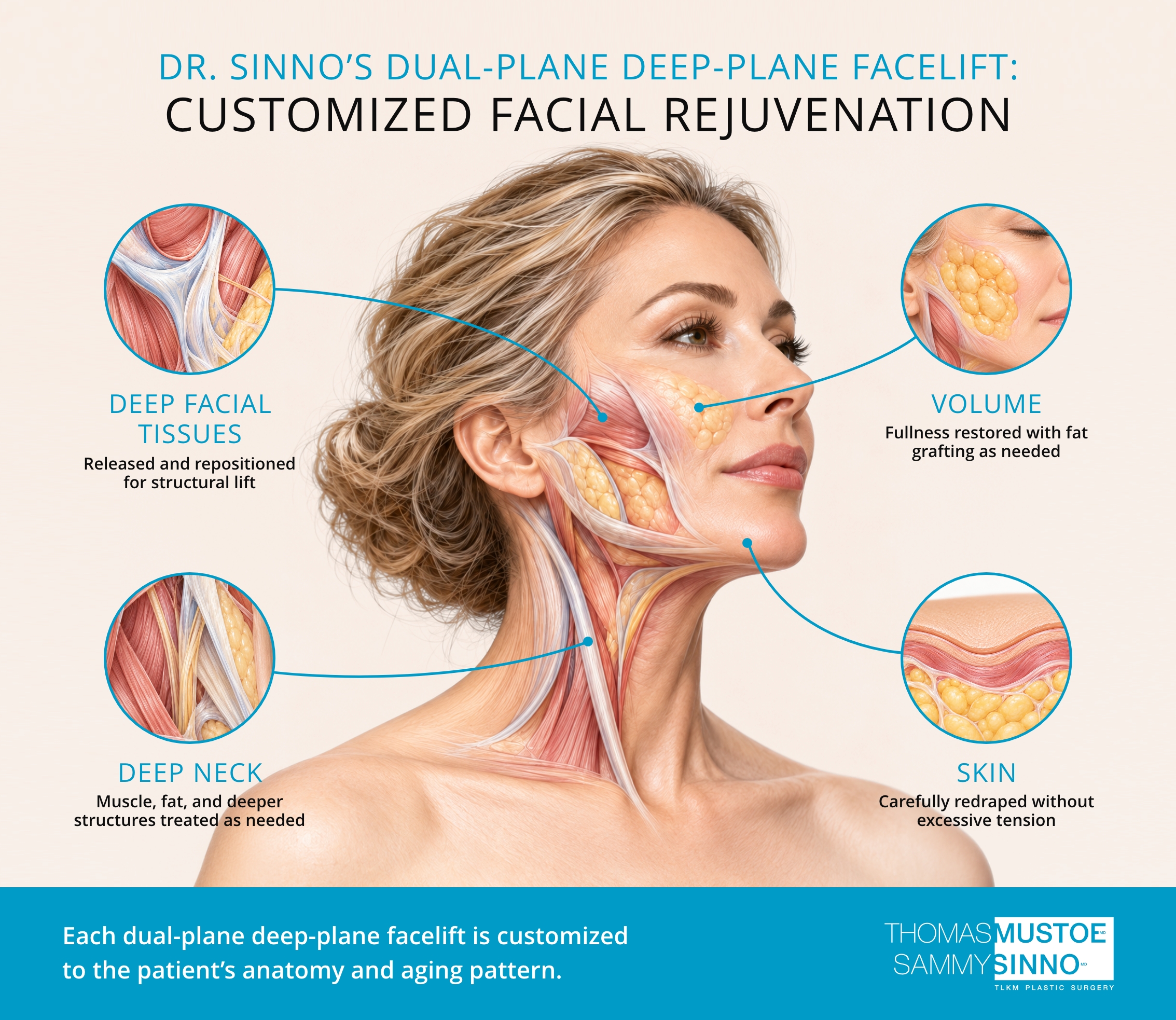
My dual-plane deep-plane facelift treats the face and neck as interconnected areas. The core facial technique combines deep-plane tissue lifting with individualized skin redraping. Depending on your anatomy and goals, I may also incorporate deep neck rejuvenation and volume restoration:
- Deep neck rejuvenation: Through a small incision beneath the chin, I can address superficial and deep fat, the platysma muscle, deeper neck muscles, and the submandibular glands, tailoring treatment to your anatomy.
- Deep tissue lifting and repositioning: Through discreet incisions around the ear and hairline, I release and elevate deeper facial tissues to address sagging and restore facial and jawline contours. This deep plane component provides the structural foundation of the lift.
- Subcutaneous work and tailored skin redraping: I tailor the work beneath the skin to each patient’s needs. Once the deeper tissues have been repositioned, I carefully redrape the skin with attention to direction and tension to complement the deep plane lift.
- Volume restoration: I may use fat grafting to restore fullness in areas such as the cheeks or temples when facial aging includes volume loss.
You may not need every component. At your consultation, I’ll evaluate your anatomy, aging patterns, and aesthetic goals to determine the best approach for you.
What Does a Dual-Plane Deep-Plane Facelift Treat?
A dual-plane deep-plane facelift can address multiple changes associated with facial and neck aging. Rather than focusing on one isolated feature, I evaluate how changes throughout the face and neck affect overall balance.
Depending on your needs, treatment may address:
- Jowls and reduced jawline definition
- Neck skin laxity and muscle banding
- Midface sagging and volume loss
- Deepening nasolabial folds and marionette lines
Aging around the eyes or brows can also contribute to an older or tired appearance, so we may consider complementary procedures such as blepharoplasty or a brow lift as part of a comprehensive facial rejuvenation plan.
What Are the Benefits of a Dual-Plane Deep-Plan Facelift?
My dual-plane deep-plane facelift combines deep tissue repositioning with individualized skin redraping. Working at both tissue levels allows me to tailor the release, lift, and skin adjustment rather than applying the same approach to every patient. When appropriate, I combine this facial technique with deep neck rejuvenation to address the face, jawline, and neck comprehensively.
Potential benefits of this approach include:
- Natural-looking rejuvenation: The deep plane component creates lift by repositioning underlying tissues, reducing reliance on skin tension.
- Comprehensive correction: The face, jawline, and neck can be evaluated and treated as a connected aesthetic unit.
- Individualized treatment: Deep plane tissue release, superficial skin mobilization, and any additional neck work are tailored to your anatomy and needs.
- Balanced volume: Fat grafting can be incorporated when restoring youthful fullness would complement the facelift.
The goal is to restore more youthful contours while preserving the characteristics that make you look like yourself.
Is a Dual-Plane Deep-Plane Facelift the Same as a Deep Plane Facelift?
Yes—my dual-plane deep-plane facelift is a deep plane facelift approach that also incorporates tailored work in the subcutaneous plane beneath the skin. “Deep plane” identifies the deeper tissue release and repositioning that forms the foundation of the lift. “Dual plane” describes how I combine that deeper work with individualized superficial skin mobilization and redraping. The terms describe complementary parts of one tailored operation.
Who Is a Candidate for a Dual-Plane Deep-Plane Facelift?
Candidates for a dual-plane deep-plane facelift typically have facial and neck aging significant enough to benefit from surgical repositioning of underlying tissues. Concerns may include jowling, midface sagging, reduced jawline definition, neck laxity, or a combination of these changes. Candidacy also depends on your health, anatomy, skin quality, goals, and expectations.
Why Is Experience Important for a Dual-Plane Deep-Plane Facelift?
A dual-plane deep-plane facelift requires detailed knowledge of facial and neck anatomy and the judgment to coordinate deeper tissue release and repositioning with superficial skin mobilization. Experience guides how much work is needed in each plane and whether additional deep neck treatment is appropriate.
My approach has evolved through more than 1,000 facelift, neck lift, and facial rejuvenation procedures, along with years of studying and publishing research on facelift outcomes and neck anatomy. I’ve also contributed multiple facelift articles to the journal Plastic and Reconstructive Surgery and shared what I’ve learned with other plastic surgeons at national and international professional meetings.
My surgical experience and academic study guide how I tailor each patient’s procedure.
Is a Dual-Plane Deep-Plane Facelift Right for You?
The best facelift approach depends on how your face has aged and what you hope to change. To learn more about the dual-plane deep-plane facelift, request a consultation using the online form or call our office at (312) 788-2560.
Leave a Reply